Bali Nyepi 2026: A Guide to the Day of Silence & Balinese Wisdom
Deep in the heart of the Indonesian archipelago lies Bali, the "Island of the Gods," where ancient rituals and vibrant culture weave a tapestry of spirituality.
For travelers seeking a unique and profound experience, Nyepi, the Balinese Day of Silence, offers an opportunity unlike any other. On March 19th, 2026, Bali will plunge into profound silence, inviting all who visit to embark on a journey of self-reflection and spiritual renewal.
Nyepi is the first day of the Balinese Saka New Year, a time of cosmic purification and spiritual awakening. Unlike typical New Year celebrations filled with fireworks and revelry, Nyepi is marked by a period of rigorous fasting, meditation, and introspection. For twenty-four hours, the island comes to a complete standstill: no lights are lit, no fires are kindled, no work is performed, and no travel is allowed outside the home. The belief is that by tricking the evil spirits into thinking the island is deserted, they will pass over Bali, allowing the island to begin the new year with a clean spiritual state.
For Western travelers accustomed to the relentless pace of modern life, Nyepi provides a powerful contrast, a rare opportunity to disconnect from the external world and reconnect with the inner self. In a society where we are constantly bombarded with noise, information, and demands on our time, the silence of Nyepi is a precious gift. It allows us to slow down, to listen to the whispers of our own soul, and to confront the thoughts and feelings that often get drowned out in the daily life.
The Balinese philosophy of Tri Hita Karana, or the "Three Causes of Goodness," underpins much of their cultural and spiritual life. This principle emphasizes the harmonious relationship between humanity, nature, and the divine. Nyepi embodies this philosophy perfectly, as the silent observation reflects a commitment to respect and protect the natural environment and to honour the spiritual realms. The absence of activity allows nature to thrive and the spirits to roam undisturbed, fostering a sense of balance and interconnectedness that resonates deeply with the human spirit.
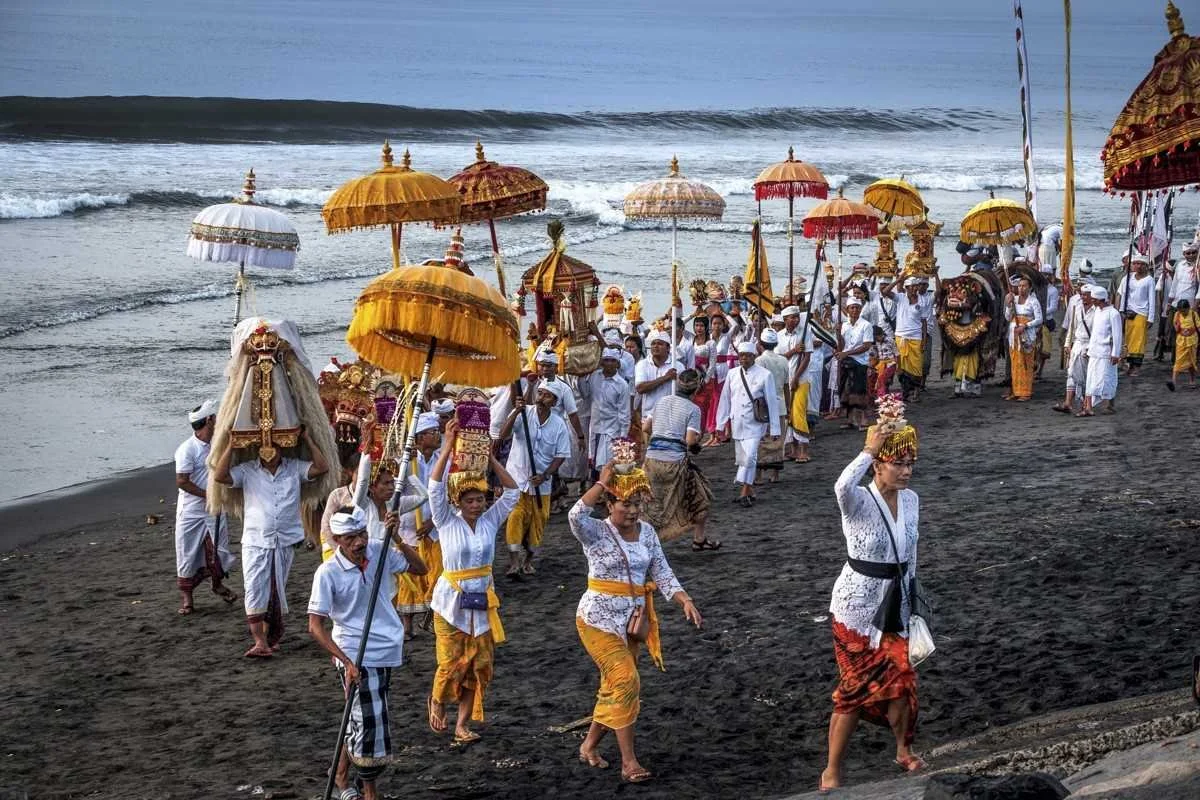
Melasti procession
The journey toward the Day of Silence begins days before with Melasti. In a stunning display of devotion, thousands of Balinese Hindus dressed in ceremonial white march in vast processions toward the sea or sacred water sources. They carry Pratima—sacred temple objects—to be bathed and purified. This ritual is a beautiful manifestation of the Balinese desire to cleanse the "Bhuana Alit" (the small world of the human soul) and the "Bhuana Agung" (the great world of the universe), reminding us in the West that our internal peace is inextricably linked to the health of our environment.
As the eve of Nyepi approaches on March 18th, the energy shifts from serene purification to vibrant exorcism during Bhuta Yajna. This is the night of the Ogoh-Ogoh parades. Villages across the island carry expertly crafted effigies of demons, representing the negative forces and vices of the past year.
Amidst the clanging of traditional gamelan music and the flare of bamboo torches, these statues are paraded through crossroads to "confuse" and lure out evil spirits.
The night culminates in the burning of these giants, a symbolic destruction of our own inner demons—ego, greed, and anger—to ensure they do not follow us into the New Year.
Then comes the dawn of Nyepi on March 19th. From 6:00 AM until 6:00 AM the following day, a transition occurs that is almost unfathomable in our hyper-connected Western world. The entire island, including the international airport, shuts down completely. During Nyepi, the Balinese observe the Catur Brata Penyepian, the four prohibitions: no fire (amati geni), no work (amati karya), no travel (amati lelungan), and no self-indulgence (amati lelanguan). These practices serve as a powerful metaphor for the purification of the mind and soul. By refraining from external activities and sensory pleasures, individuals are forced to turn their gaze inward, to confront their desires, attachments, and negative emotions, and to cultivate a sense of inner peace and equilibrium.
This is not merely a set of rules, but a collective meditation. By making the island appear deserted and dark, the Balinese believe they trick wandering evil spirits into passing over the island. For the modern traveler, it is a forced but welcome "digital detox" and a lesson in the power of stillness. It is a day where the only sounds are the rustle of palm fronds and the distant barking of dogs, offering a rare sanctuary for deep contemplation.
The cycle concludes with Ngembak Geni, the day of "relighting the fire." On March 20th, the island breathes again. Families visit one another to perform Dharma Canthi, a ritual of seeking and giving forgiveness. This mirrors the universal need for social harmony we all crave. It is a reminder that after the silence must come connection, and after introspection must come the renewal of our relationships.
The silence of Nyepi is not a passive or empty state. It is a vibrant and potent silence, filled with the energy of collective introspection and spiritual resonance.
It is a time for prayer, for chanting mantras, and for offering sacrifices to the gods and ancestors. It is a time for forgiveness, for reconciliation, and for resolving conflicts within families and communities. It is a time for renewal, for rebirth, and for welcoming the new year with a renewed sense of purpose and commitment.